The task At Project Neutron I write benchmark problems and reference solutions used to train and evaluate AI models for structural design and construction. A model is only as good as what you measure it against, so each problem needs an answer that is correct, fully worked, and independently checkable.
This one is a structural adequacy check on an isolated spread footing. The model under test is given a drawing sheet and asked whether the footing is adequate for the stated column load. My job was to produce the answer it gets scored against.
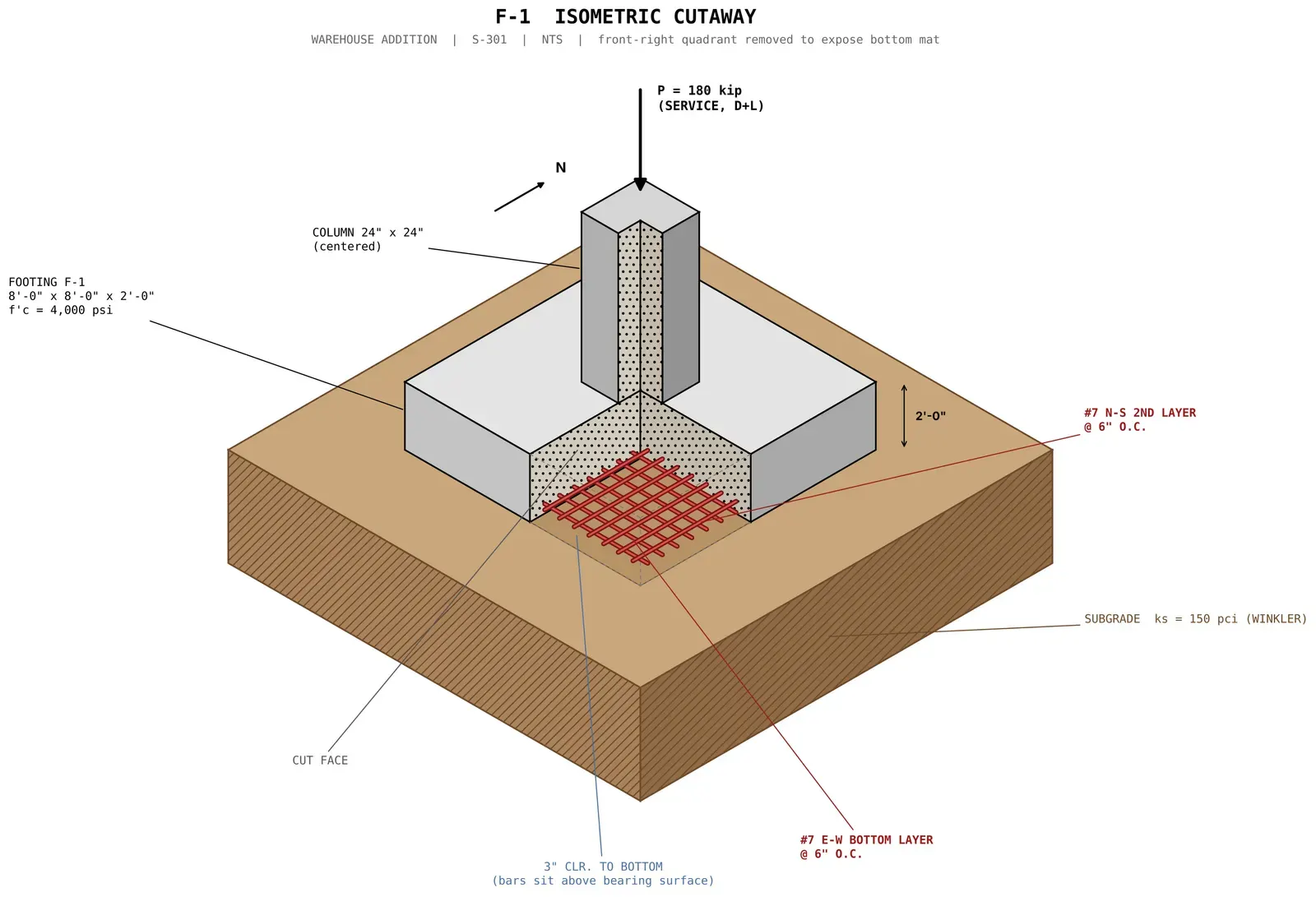
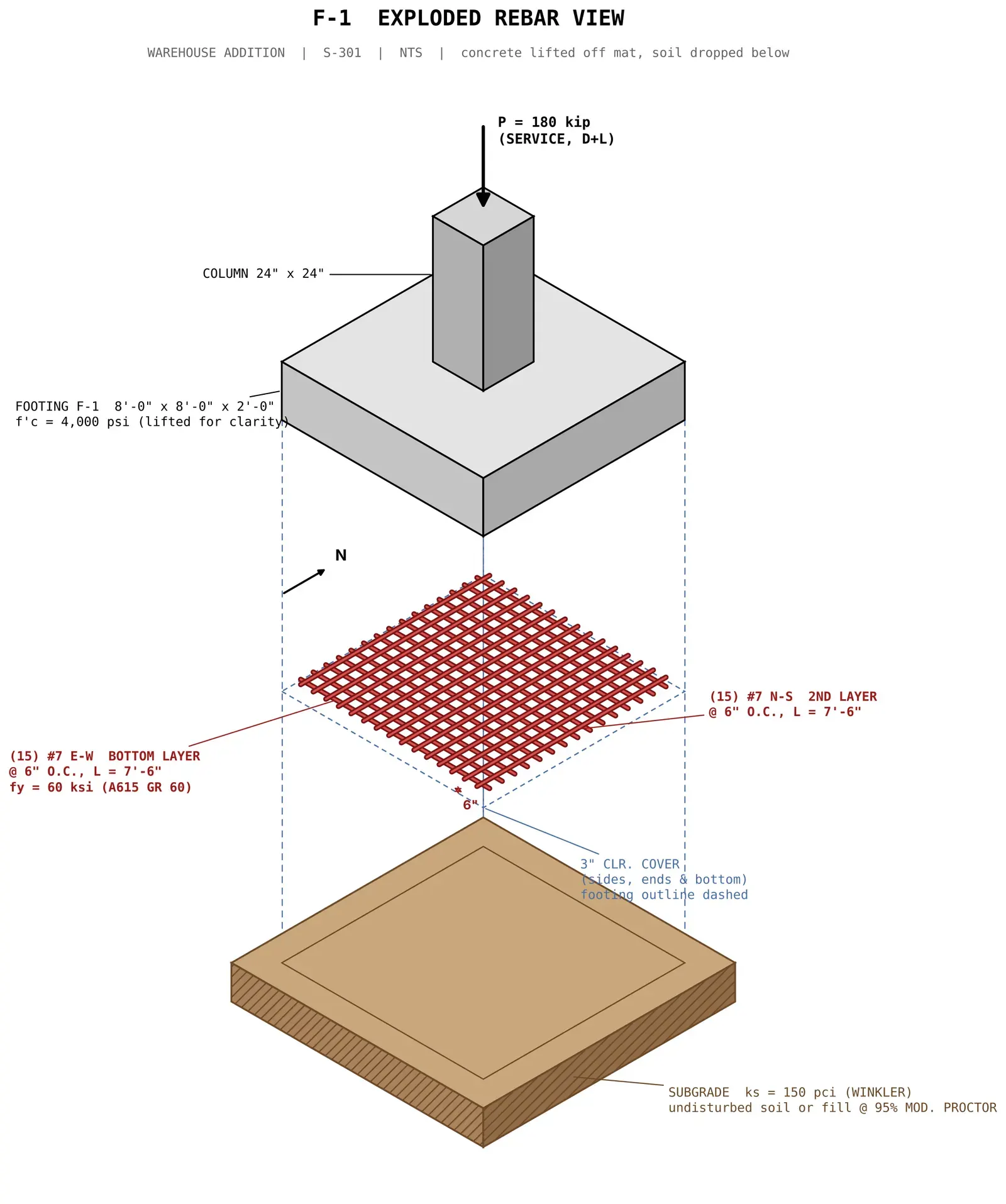
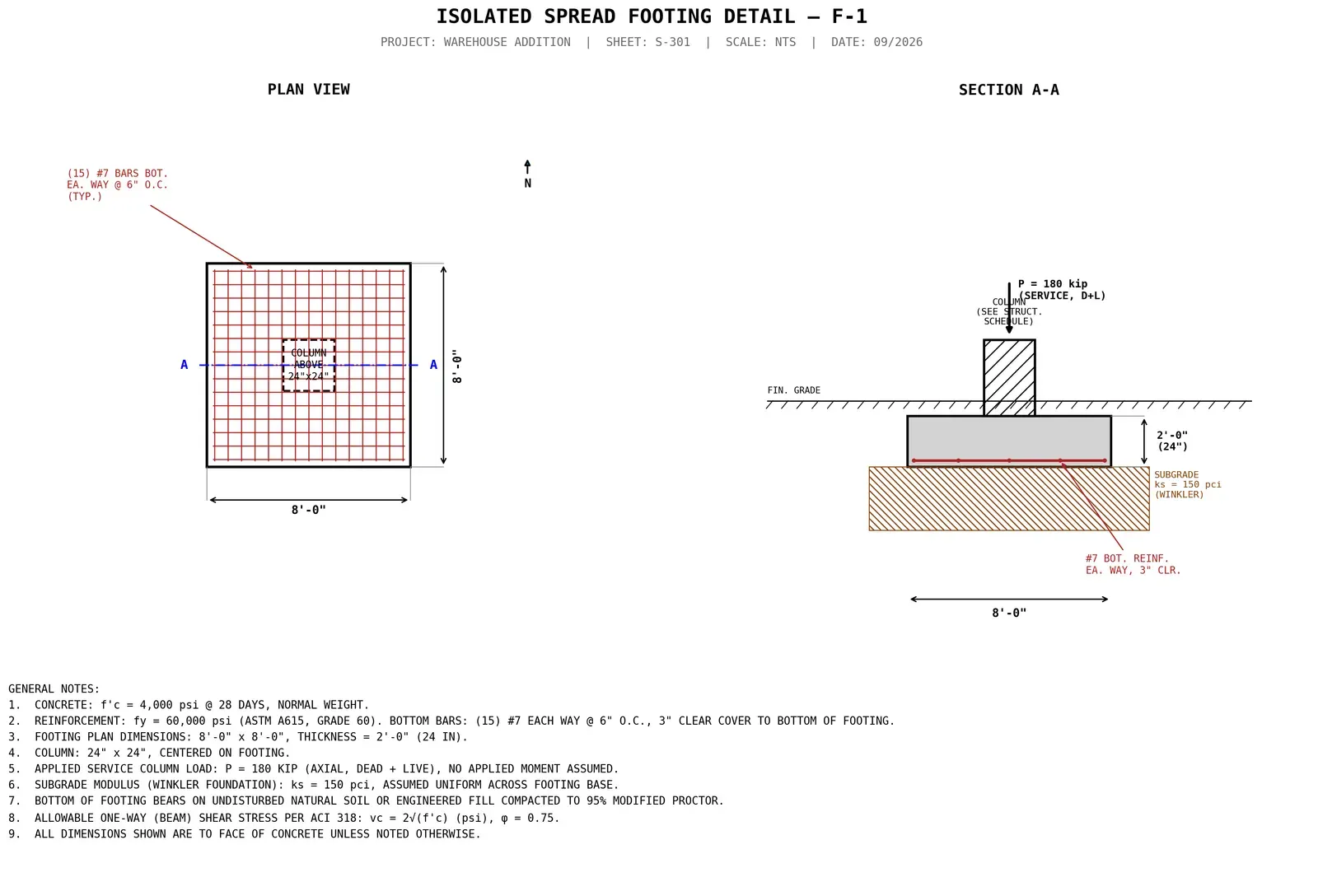
Design basis Every input was extracted from the drawing itself rather than assumed, and each traced to the note it came from:
Footing: 8’-0" × 8’-0" × 2’-0" thick Column: 24" × 24", centred Concrete: f’c = 4,000 psi · Reinforcement: Grade 60, fy = 60,000 psi Bottom steel: (15) #7 each way @ 6" o.c., 3" clear cover Service column load: P = 180 kip (D + L, no split given) Subgrade modulus: ks = 150 pci (Winkler) Effective depth: d = 20.56 in Because the drawing gives a combined service load with no dead/live split, the factored checks use Pu = 1.6P = 288 kip — treating the whole load as live, which is the more severe ACI case.
Method, and why it was chosen The honest answer to “is this footing adequate” depends on whether it behaves as rigid or flexible, so that question gets settled first rather than assumed:
Ec = 57,000√f’c = 3,605 ksi · D = Ec·t³/[12(1−ν²)] = 4.33 × 10⁹ lb·in L = (D/ks)^0.25 = 73.3 in, against a footing half-width of 48 in
L exceeds the half-width, so the footing classifies as rigid and uniform bearing pressure is the correct idealisation. That justifies solving it with the classical rigid-footing method combined with Hetényi elastic-foundation theory, rather than a full flexible-plate finite element solve — and every number stays hand-checkable, which matters when the whole point is to be a reference.
The plan geometry was meshed in Gmsh, refined around the column footprint.
Results Service bearing pressure q = P/A = 2.81 ksf; factored qu = 4.50 ksf. Uniform settlement δ = q/ks = 0.130 in.
Check Demand Capacity (φ·nominal) Ratio One-way (beam) shear 46.3 kip 187.3 kip 0.25 Two-way (punching) shear 225.9 kip 695.4 kip 0.32 Flexure, bottom steel 162.0 kip·ft 799.3 kip·ft 0.20 All three pass. Punching shear governs at a demand/capacity ratio of 0.32. At service loads the elastic bending stress is 131.8 psi against a modulus of rupture of 474.3 psi, so the section is uncracked — consistent with the large flexural reserve.
Conclusion The footing as detailed is adequate for the 180 kip service load, and conservatively so: with the governing ratio at 0.32, both the thickness and the reinforcement are well above what this load case requires.
For benchmarking purposes that conservatism is useful — a model that declares the footing inadequate, or that misidentifies which check governs, fails in a way that is unambiguous.